Europe’s Strategic Crossroads: A Strategic Brief
Early 2026: A Structural Test for Europe
As of early 2026, Europe faces simultaneous pressure from three major power centers, each operating through different instruments of influence.
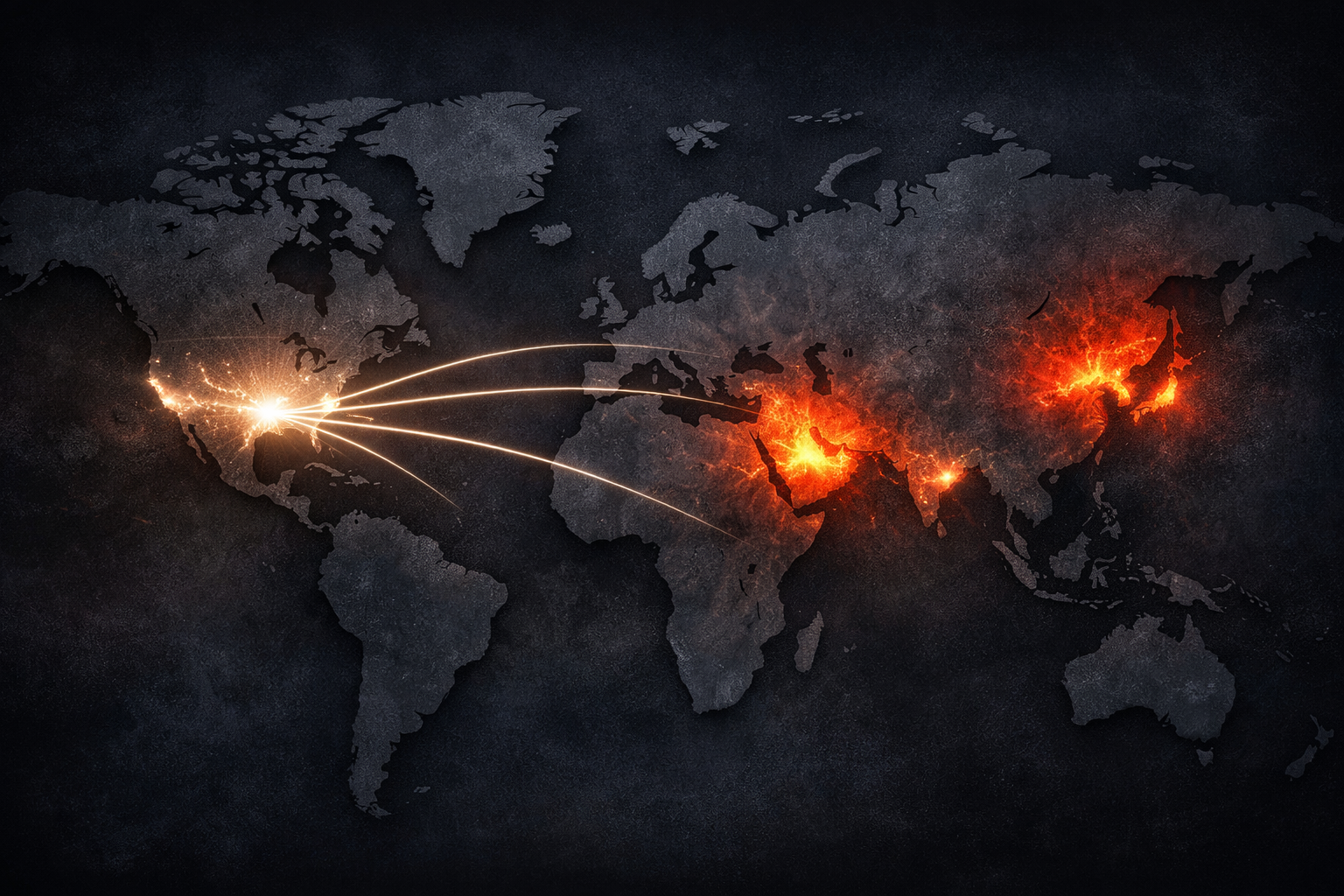
In January 2026, U.S. President Donald Trump reiterated interest in negotiating the purchase of Greenland — a self-governing territory within the Kingdom of Denmark — while stating that no military force would be used. Although no territorial change has occurred, the renewed proposal reintroduced uncertainty into transatlantic political discourse.
Meanwhile, Russia’s war in Ukraine continues into its fourth year. European states remain deeply involved through financial assistance, military support, and sanctions enforcement.
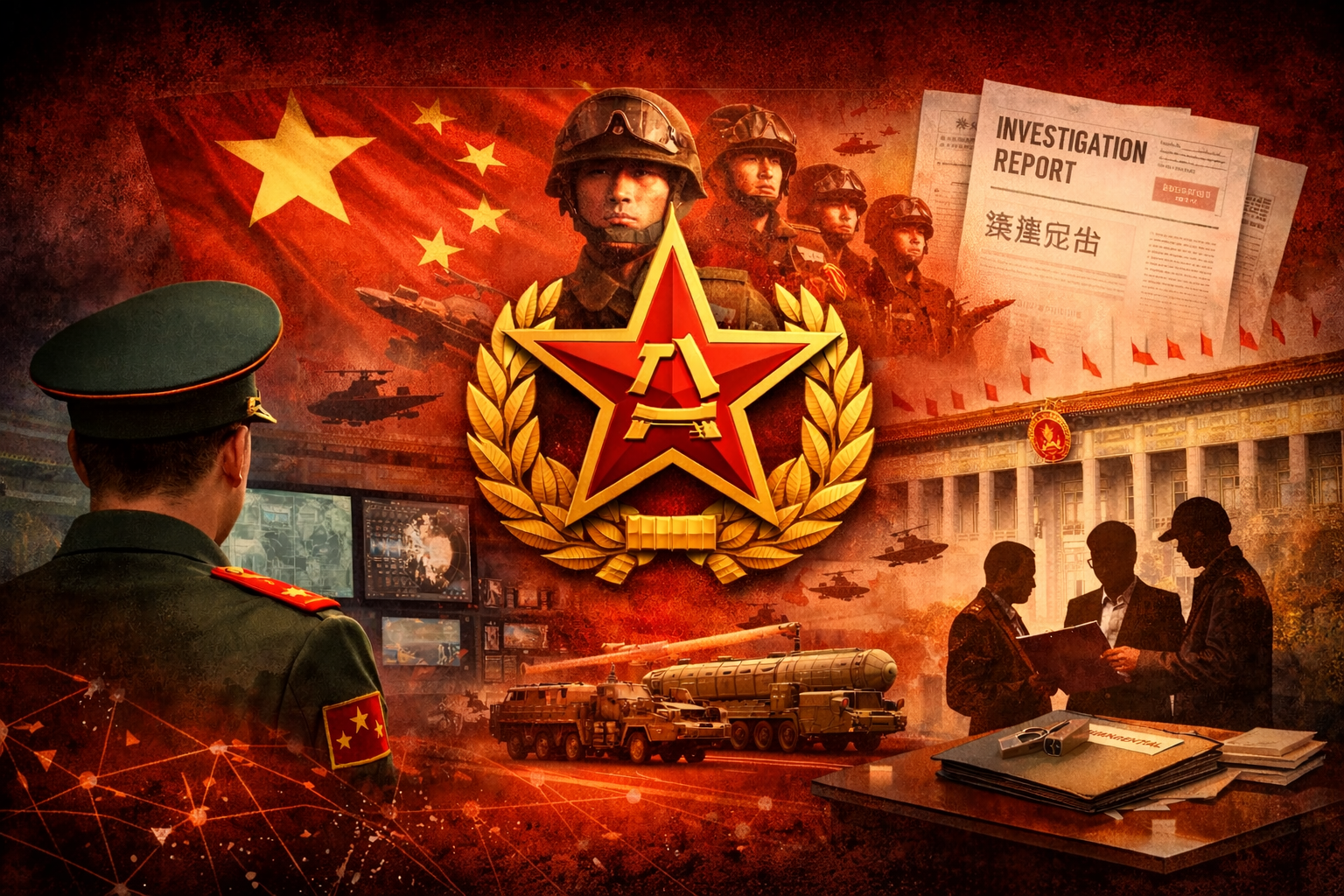
At the same time, tensions between the European Union and China have intensified over trade imbalances, electric vehicle exports, and industrial competition.
These developments are not isolated events. Together, they represent a structural stress test for Europe’s position in an increasingly multipolar order.
Three Distinct Forms of Pressure
1. Alliance Uncertainty from Washington
The Greenland proposal does not constitute aggression. It does, however, signal a shift in tone.
When a leading NATO power publicly discusses acquiring territory from a European ally — even through negotiation — it raises questions about the long-term predictability of transatlantic relations.
The strategic issue is not whether Greenland changes sovereignty. It is whether Europe can assume structural continuity in its security partnership with the United States.
For decades, European defense planning operated under the assumption of stable American leadership within NATO. Even rhetorical deviations now carry weight in a more uncertain geopolitical climate.
2. Direct Military Threat from Moscow
Russia’s war in Ukraine remains the clearest hard-power challenge facing Europe.
The conflict has:
- Increased European defense expenditures
- Strengthened NATO’s eastern posture
- Reshaped energy policy and supply chains
- Accelerated coordination among EU member states
Unlike the Greenland debate, this pressure is kinetic and ongoing.
The war reinforces the perception that territorial revisionism remains a live risk in Europe’s security environment. It compels sustained military preparedness and strategic unity.
However, the longer the conflict persists, the greater the economic and political strain within Europe itself.
3. Economic Leverage from Beijing
China’s pressure manifests not through military coercion but through industrial scale and trade dynamics.
European policymakers face mounting concern over:
- Industrial overcapacity in Chinese exports
- Electric vehicle competition
- Supply chain dependencies
- Trade imbalances
The challenge for Europe is calibration.
Full economic decoupling would be costly and impractical. Yet unrestricted openness risks deindustrialization in strategic sectors.
The emerging European approach — often described as “de-risking” rather than decoupling — reflects an attempt to manage exposure without triggering systemic economic rupture.
Europe’s Strategic Dilemma
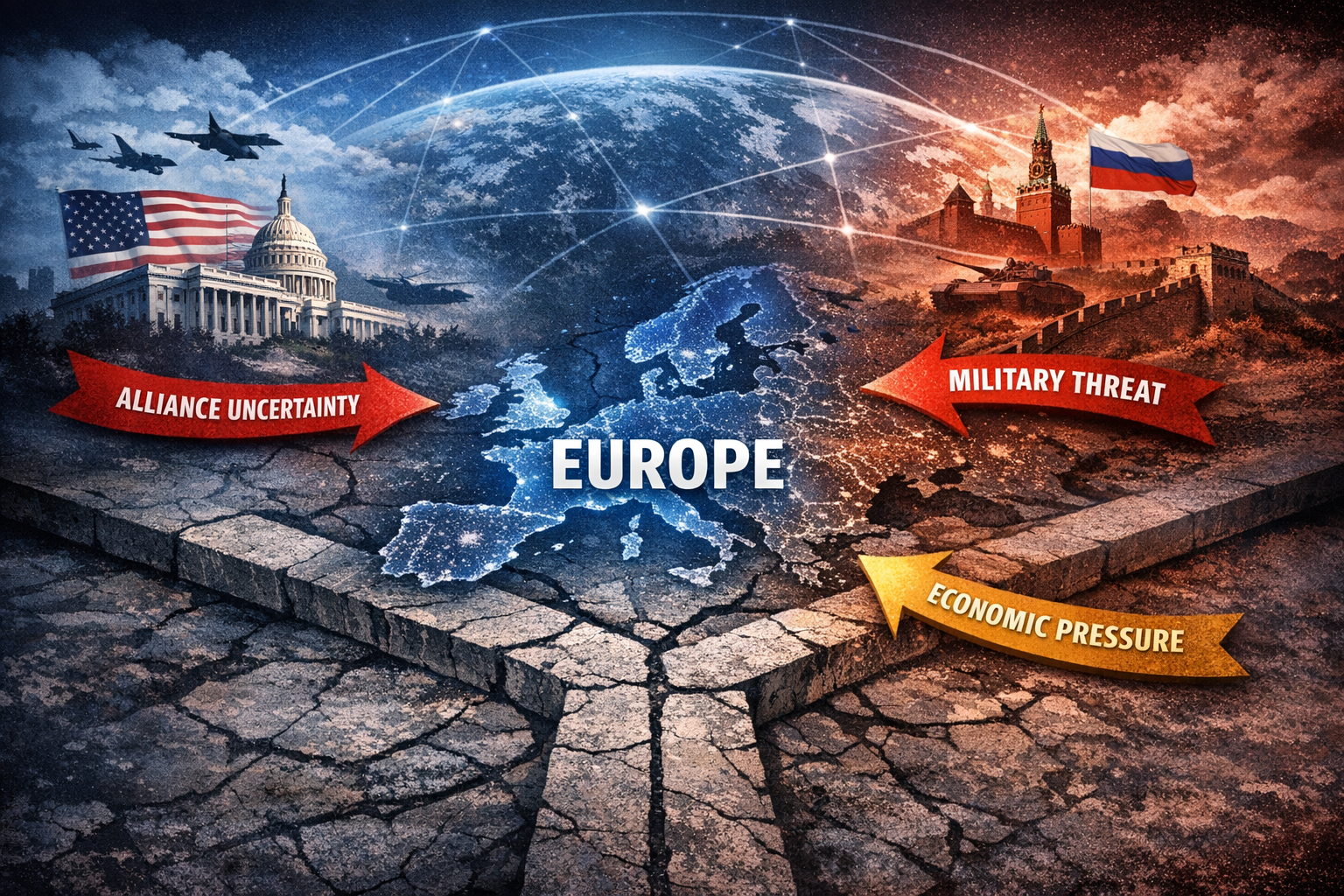
Europe’s challenge is not choosing between three powers. It is managing three qualitatively different pressures at once.
| Actor | Nature of Pressure |
|---|---|
| United States | Alliance uncertainty |
| Russia | Military threat |
| China | Economic leverage |
Each demands a distinct policy response.
Yet policy coherence must be maintained across all three.
This is the essence of Europe’s strategic crossroads.
Strategic Options
Three broad pathways are visible.
A. Deep Atlantic Alignment
Europe could double down on NATO reliance and align closely with Washington across security and economic policy.
This would reinforce deterrence against Russia but reduce flexibility in managing China and increase exposure to fluctuations in U.S. domestic politics.
B. Accelerated Strategic Autonomy
Europe could significantly expand defense integration, industrial sovereignty, and independent geopolitical capacity.
This would strengthen resilience but require sustained political unity, fiscal coordination, and institutional reform — all of which face internal constraints.
C. Hybrid Hedging Strategy
The most plausible near-term path is hybrid hedging:
- Preserve NATO centrality
- Gradually strengthen European defense capacity
- Apply targeted economic de-risking toward China
- Avoid abrupt realignment
This approach minimizes systemic shock while incrementally increasing autonomy.
Internal Constraint: The Decisive Variable
External pressure alone does not determine Europe’s trajectory.
Internal cohesion remains decisive.
Fiscal divides between northern and southern member states, varying threat perceptions between eastern and western Europe, and the rise of nationalist political currents complicate strategic coordination.
Europe’s ability to recalibrate under pressure depends less on the intensity of external threats and more on its capacity to maintain political alignment.
Multipolar Implication
In a multipolar transition, actors under simultaneous pressure often become systemic pivots.
Europe is neither collapsing nor fully consolidated as a third pole.
It occupies an intermediate position — economically powerful, militarily dependent in part, politically complex.
If Europe succeeds in strengthening strategic coherence without severing alliances, it may gradually evolve into a stabilizing third center within the multipolar system.
If internal fragmentation deepens, Europe risks becoming a contested arena rather than an autonomous actor.
The crossroads Europe faces in 2026 is therefore not about immediate crisis management.
It is about structural positioning in an emerging global order where power is diffused, alliances are fluid, and equilibrium remains unsettled.