The war in Ukraine is often described as a territorial conflict between two neighboring states. That description is incomplete.
What began as a military invasion has evolved into a structural confrontation over the future balance of power in Europe — and by extension, the global order itself.
To understand where this war is heading, we must first understand what it is really about.
I. The Structural Fault Line
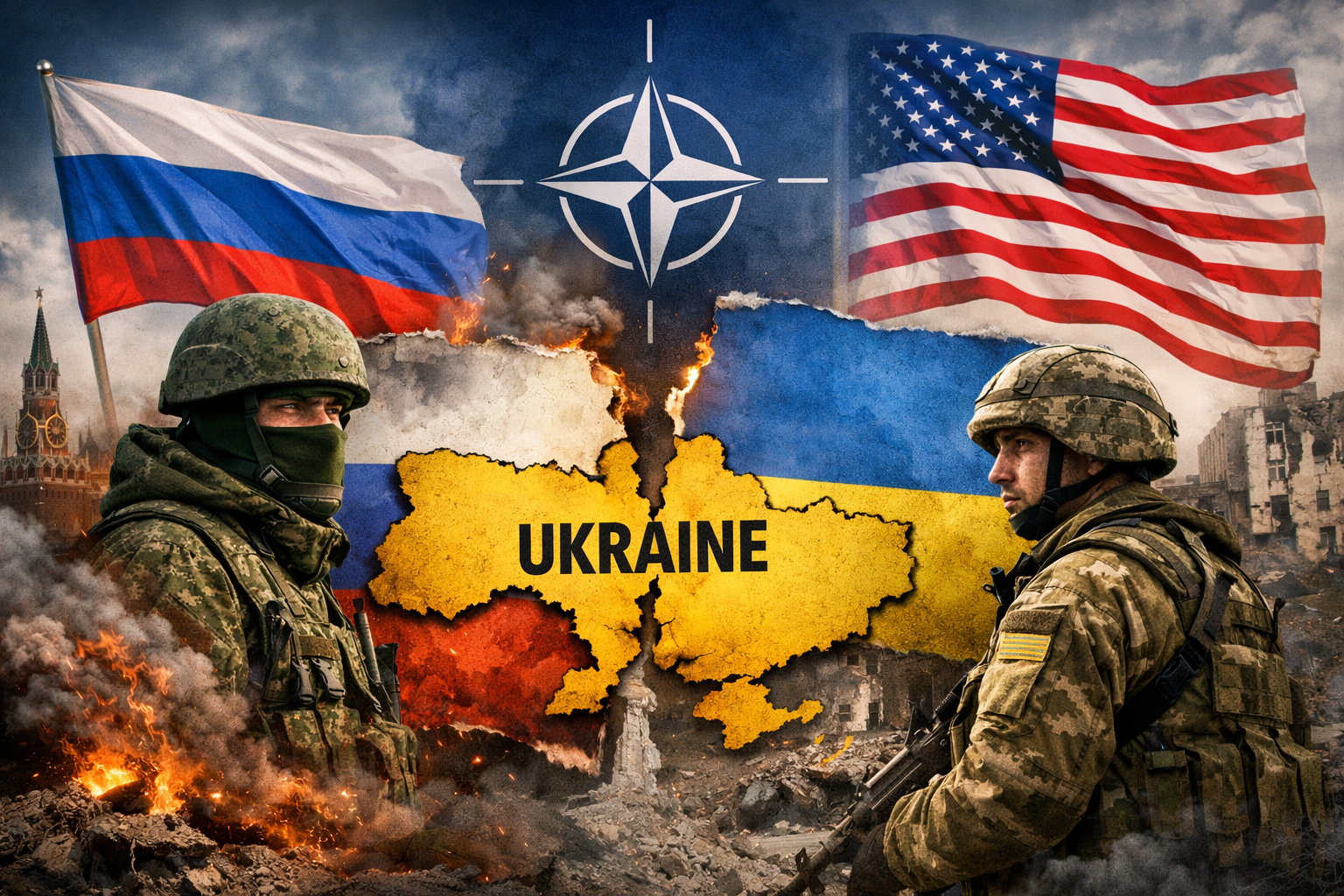
At its core, the Ukraine war reflects a clash between two incompatible security visions.
On one side stands Russia, seeking to preserve strategic depth and prevent further encroachment by NATO.
On the other stands Ukraine, asserting sovereign choice in its foreign policy orientation — backed politically and militarily by Western states.
After the Cold War, NATO expanded eastward. From Western capitals, this was framed as voluntary enlargement. From Moscow, it was perceived as strategic containment.
Ukraine became the hinge state.
Once Kyiv moved decisively toward Western alignment after 2014, Moscow interpreted the shift not as diplomacy, but as irreversible geopolitical loss.
II. The War That Was Supposed to Be Short
Russia’s 2022 invasion appeared to be designed for speed:
- Rapid political destabilization.
- Military pressure sufficient to force neutrality.
- Limited Western response.
Instead, three unexpected dynamics reshaped the battlefield:
- Ukrainian resistance proved cohesive.
- Western military support became sustained rather than symbolic.
- Sanctions turned structural, not temporary.
The war transitioned from coercive intervention into long-term attrition.
III. Where Things Stand Now
Today, the war resembles a strategic stalemate.
Russia holds territory in eastern and southern Ukraine.
Ukraine retains sovereignty, cohesion, and external backing.
Neither side has achieved decisive victory.
Both sides face mounting costs.
Meanwhile, Europe has increased defense spending dramatically, and NATO has expanded to include Finland and Sweden — a development that complicates Moscow’s original security objective.
The battlefield has stabilized. The geopolitical contest has not.
IV. The Negotiation Dilemma
Peace talks are often discussed, but serious negotiation requires answers to three unresolved questions:
- What happens to occupied territories?
- What security guarantees would make Ukraine feel protected?
- How does Russia present an outcome domestically without appearing defeated?
Without credible enforcement mechanisms and political cover for both leaderships, negotiations remain fragile.
The war may not end when one side wins. It may end when both sides calculate that continued fighting no longer improves their position.
V. The Strategic Calculations of Each Actor
Russia
Russia’s strategic objective appears to be preventing Ukraine from becoming a permanent Western military platform.
Yet the cost has been significant:
- Long-term economic isolation.
- Increased dependence on China.
- A strengthened NATO posture along its borders.
Territorial gains may bring tactical advantage, but they also lock Russia into prolonged confrontation.
Ukraine
Ukraine’s strategy rests on endurance:
- Preserve sovereignty.
- Maintain Western support.
- Outlast Russian political will.
The risk is war fatigue — both domestically and among partners.
Ukraine’s survival has strengthened its national identity. But the cost has been existential.
Europe
Europe has emerged more strategically aware.
Energy diversification, defense investment, and greater discussion of “strategic autonomy” signal a shift.
Europe is not abandoning the United States — but it is reducing complacency.
The United States
For Washington, the war has reinforced leadership within NATO while degrading a rival power without direct military confrontation.
However, domestic debate over burden-sharing and global priorities continues.
The real test is sustainability.
VI. Who Ultimately Gains?
There is no clear victor.
Russia gains territorial leverage but loses economic integration.
Ukraine gains global support but suffers enormous destruction.
Europe gains strategic urgency but absorbs economic strain.
The United States preserves influence but faces political polarization.
In reality, this war redistributes risk more than it delivers victory.
VII. What This War Really Means
The Ukraine war is not simply about borders.
It is about whether:
- Spheres of influence will define Europe’s future, or
- Sovereign alignment choices will remain protected under alliance structures.
The outcome will shape not just Eastern Europe, but the credibility of collective security in a multipolar world.
The war may freeze before it resolves.
But the structural rivalry it exposed will endure.
The decisive variable is not territory.
It is resilience — economic, political, and strategic.