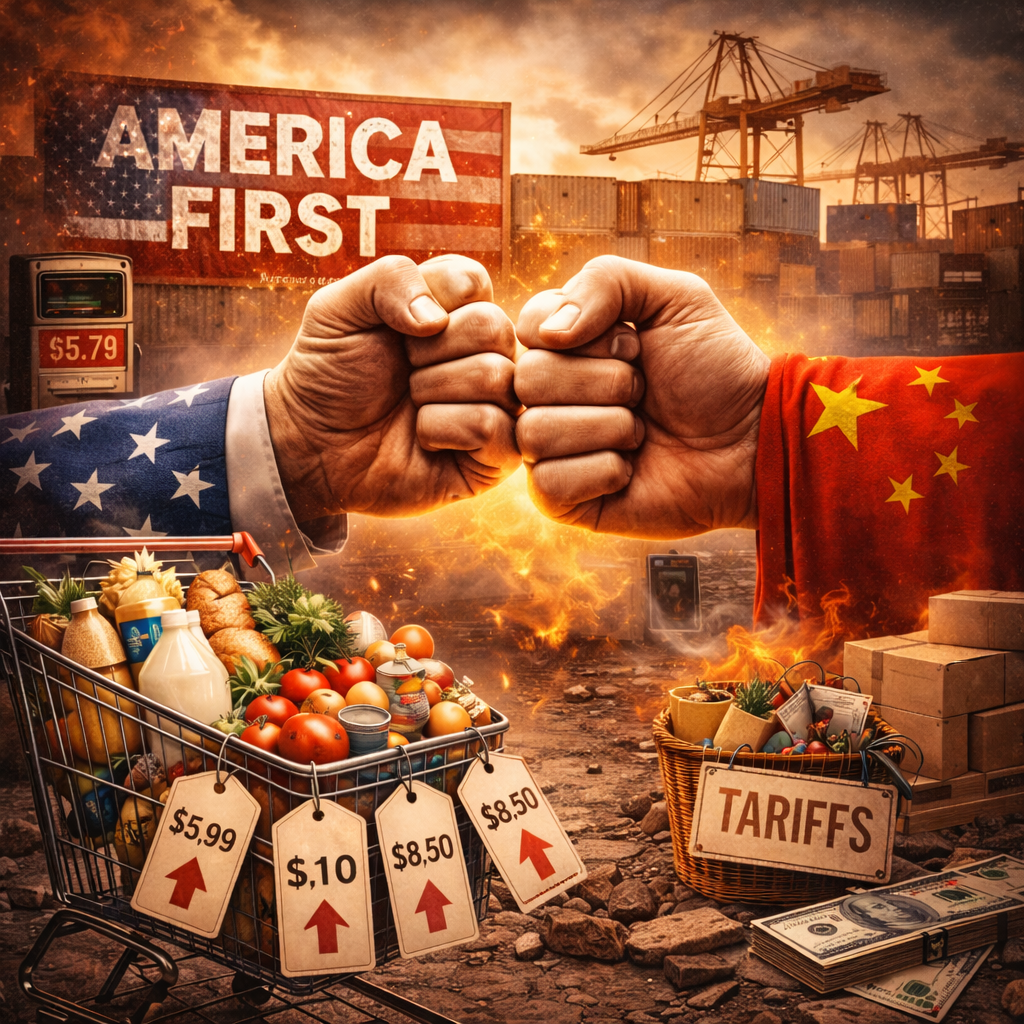
Why Tariffs Can’t Bring Back the Economy We Remember
At first glance, the reason prices are rising in the United States seems straightforward.
Tariffs raised costs. Imports became more expensive. Consumers paid the difference.
This is not a controversial claim. Even many supporters of Donald Trump acknowledge it.
Tariffs, after all, are taxes. And taxes are rarely absorbed quietly.
But focusing only on tariffs misses the deeper issue.
The real question is not why prices rose, but why the strategy behind those tariffs no longer delivers what it once promised.
The Logic Behind the Tariffs Was Not Irrational
The goal of “America First” trade policy was clear:
pressure companies to bring production back home, rebuild manufacturing, and restore middle-class jobs.
Thirty years ago, this logic might have worked.
The United States still had a large industrial labor force.
Wages were lower. Global supply chains were less complex.
Manufacturing at scale on U.S. soil was difficult—but not implausible.
The idea that higher tariffs could force a reshoring of production made sense then.
The Problem Is Not the Goal — It’s the Timing
The American economy of today is not the American economy of the 1990s.
Labor costs are structurally higher.
The workforce is older, more service-oriented, and less willing to take physically demanding, low-wage factory jobs.
Entire regions that once supported mass manufacturing have transitioned—or declined.
This is not a moral judgment. It is a structural reality.
Trying to recreate a low-cost manufacturing economy in a high-income, post-industrial society does not reduce prices.
It raises them.
When production moves back to the United States, it does not return as cheap goods.
It returns as premium goods.
What Actually Happened Instead of “Coming Home”
In practice, tariffs did not bring manufacturing back to America at scale.
They redirected it.
Companies shifted production from China to Vietnam, India, Mexico, and Eastern Europe.
Supply chains became more resilient—but also more expensive.
This process, often described as friend-shoring or near-shoring, prioritizes reliability over efficiency.
That trade-off has a cost.
The era of ultra-cheap globalization is over.
And no tariff policy can reverse that without imposing significant pain at home.
The Uncomfortable Truth: The U.S. Has Passed a Point of No Return
This is the hardest reality for politicians to admit.
The United States cannot return to being the world’s low-cost factory.
Not because it failed—but because it succeeded.
High wages, strong consumption, and a service-driven economy are signs of prosperity, not weakness.
But they also mean that reshoring manufacturing will never recreate the price environment Americans remember.
The economic clock does not run backward.
Why Prices Will Stay Higher — Even Without New Tariffs
Even if all tariffs disappeared tomorrow, prices would not return to their old levels.
Energy security costs more.
Supply-chain redundancy costs more.
Geopolitical risk costs more.
The United States is no longer optimizing solely for cheap goods.
It is optimizing for stability, resilience, and strategic independence.
Those priorities are legitimate.
But they are not free.
Why the Message Still Resonates
Despite these realities, “America First” remains politically powerful because it speaks to loss—not economics.
It speaks to communities hollowed out by deindustrialization.
To workers who remember when a factory job meant dignity and security.
To a sense that something valuable was taken away.
That emotional truth is real.
But it does not change the economic structure underneath.
Tariffs promise restoration.
What they deliver is adjustment—at a higher price.
The Cost We Rarely Acknowledge
The rising cost of imported goods is not merely a policy mistake or a partisan failure.
It is the price of transition.
Americans are paying more not because the country is weaker, but because the global system that once made everything cheap has fractured.
Security now competes with efficiency.
Stability competes with scale.
And leadership carries a premium.
Conclusion
“America First” did not fail because its supporters misunderstood America’s interests.
It failed because it underestimated how much America—and the world—has changed.
Tariffs can shift supply chains.
They can alter leverage.
They can send political signals.
But they cannot resurrect an economic model that no longer fits the country that America has become.
The uncomfortable truth is this:
Americans are paying higher prices not because policy went wrong,
but because the era of cheap global production is over—and there is no painless way back.


